
MoorHub is a UK marketplace for long-stay boat moorings, and it is opening shortly. We are onboarding mooring site operators now, loading their berths, prices and availability into one place so that boat owners can search, compare and book them properly for the first time. This is what the platform does, and why we think the way moorings currently change hands is broken at both ends.
Finding a mooring should not be this hard
If you have looked for a berth recently you will recognise the process. You search for marinas within driving distance, you find a website that may or may not say whether anything is free, you ring during office hours, you are told there is a waiting list, and you are invited to email in. You repeat this fifteen times. Weeks later you have a spreadsheet of half-answers and no reliable sense of whether the price you have been quoted is fair.
The specific failures are worth naming, because each one is fixable:
No single place to look. Berths are scattered across marina websites, club noticeboards, Facebook groups and word of mouth. There has never been a national listing you could actually search.
Listings that omit the one thing that matters. A berth either fits your boat or it does not. Maximum length, beam and draught are frequently missing, so you make the call, describe your boat, and find out the hard way.
Price opacity. Without comparable listings side by side, you cannot tell a fair price from a poor one. Two berths on the same stretch of canal can differ by hundreds of pounds a year for reasons nobody explains, and the only way to spot it today is to ring round until a pattern emerges.
Waiting lists you cannot see into. Often kept informally, rarely ranked, and easy to fall off. The boater who happens to ring in the right week gets the berth.
Nothing to compare on but price. Parking, showers, metered electricity, pump-out, hard standing: the things that decide whether a berth actually works for you are buried in prose, if they are stated at all.
No sense of the timeline. Availability dates are rarely published, so you cannot tell whether a berth frees up in three weeks or next spring, and you plan a boat purchase around a guess.
Our guide to finding a long-stay mooring sets out how to work around all of this manually. It should not have to be that much work.
Operators have the mirror-image problem
It is tempting to frame this as boaters versus marinas, but operators are badly served by the same broken market. Talk to anyone running a site and the same frustrations come up:
Empty berths earn nothing. A berth vacant for three months is revenue that cannot be recovered later. Yet the demand exists; it simply has no efficient way of finding the vacancy.
Enquiries that were never going to fit. A large share of calls are about boats too long, too wide or too deep for anything on site. Every one of them costs staff time and produces nothing.
Advertising that does not reach boaters. A vacancy notice on your own website is only seen by people who already know your site exists. The boater looking for a berth on your waterway may never find you.
Guesswork on price. Setting a rate without visibility of what comparable berths elsewhere are achieving means either leaving money on the table or sitting on an empty berth.
Administration that scales badly. Waiting lists in a notebook, availability in a diary, and a mailbox of enquiries at different stages is a lot of overhead for something that should be a listing and a booking.
The underlying problem is the same one boaters have, seen from the other side: there is no shared, structured record of what is available. Everyone maintains their own version of it, badly, and the market clears far more slowly than it should.
What MoorHub will do
The platform is built around one idea: a berth listing should carry every fact a boater needs to rule it in or out, and then let them act on it without a fortnight of phone tag.
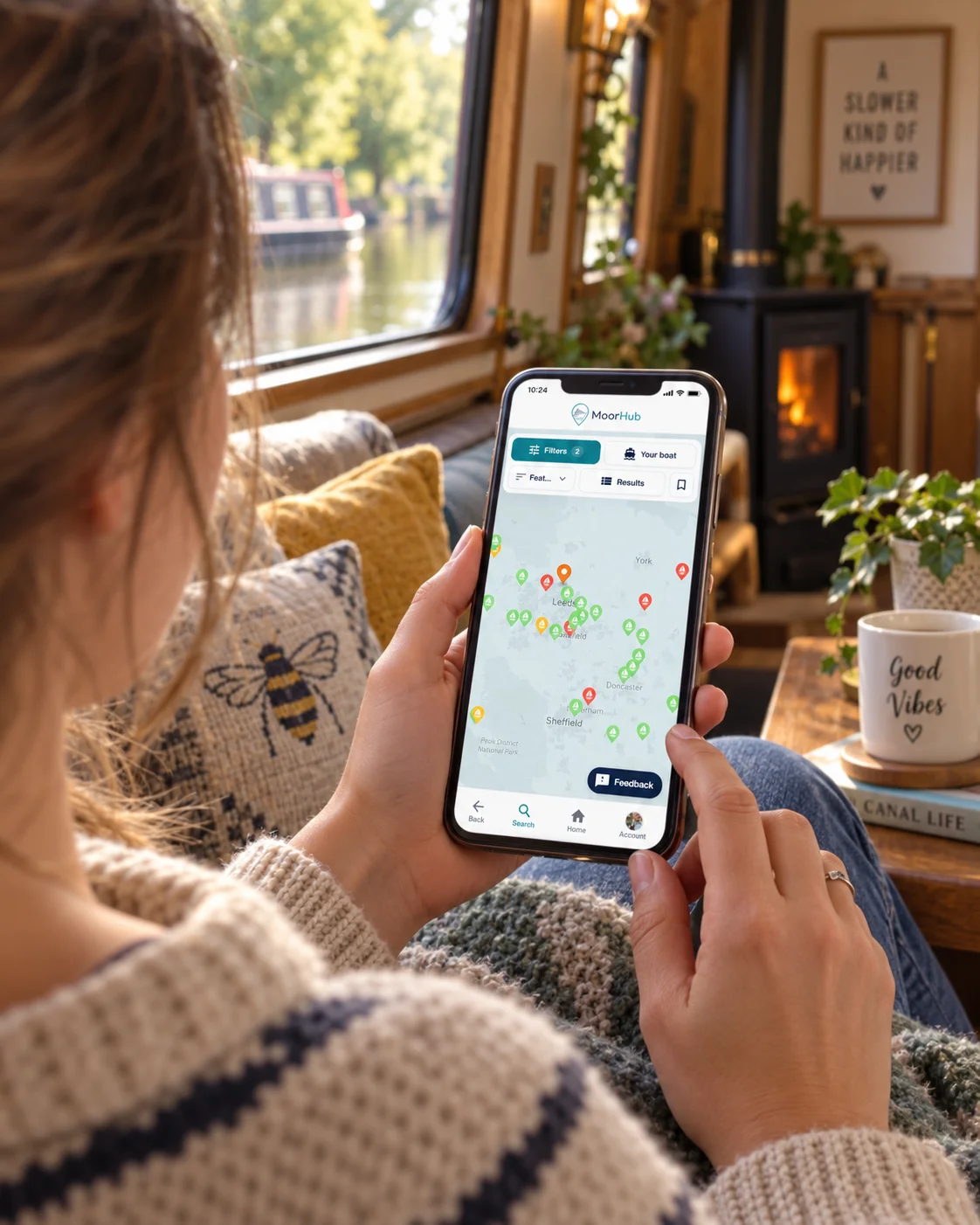
Search and filtering that reflects how you actually choose
Every listing is structured, so every field is filterable. You will be able to narrow by:
Boat size: maximum length, beam and draught, so berths that cannot take your boat never appear.
Price: advertised on a like-for-like monthly basis, whatever the contract length.
Facilities: electricity, drinking water, pump-out and Elsan disposal, showers, toilets, laundry, car parking, hard standing, onsite storage, refuse disposal and WiFi.
Location, on a map: because commuting distance and parking decide whether you actually use the boat.
Waterway: filter to the canal or river you want to cruise from.
Coverage grows as operators come on board. We are prioritising the waterways where demand is heaviest, and we will publish real coverage (sites, berths and waterways) when the marketplace opens, rather than trailing numbers before they mean anything.
Direct booking with the operator
When you find the berth you want, you book it with the operator through the platform rather than starting a fresh email thread. The operator sees the boat's dimensions and intended use up front, so the conversation starts from a berth that fits. No intermediary, no chasing.
Auctions for the berths everyone wants
Some berths are genuinely oversubscribed, and a first-come-first-served waiting list is a poor way to allocate them. It rewards timing rather than genuine demand, and it puts the operator in the awkward position of deciding who was first. Operators can instead list a berth as an auction with a starting price and let interested boaters bid openly.
One thing to understand before you assume auctions are the cheaper route: a starting price is not a settled price. Judge an auction listing on the figure you would realistically end up paying, not the number it opens at, and set yourself a ceiling before you bid.
Where we are right now
We are in onboarding. Operators are being set up with their sites, berths and vacancies, and listings are being loaded and checked ahead of opening the marketplace to boat owners. We have not announced a public launch date, and we would rather open with real, accurate inventory than hit a date with an empty map.
If you run a mooring site, now is the time to get in touch. Listings loaded before launch are the ones boaters see on day one, and onboarding early means your berths and photographs are checked properly rather than rushed.
If you are looking for a berth, work out your non-negotiables now: length overall with fenders, beam, draught, the waterway you want to be on, and whether you need residential use. Those are the constraints every search starts from, and having them written down turns a long browse into a short one.
Find a long-stay mooring
Filter berths by boat dimensions, price, facilities, waterway and location on the map.
Sources and further reading
Whatever mooring you take, the boat still needs its own licence, safety certification and insurance, and our guide to the Boat Safety Scheme and insurance explains the order to get them in. The authorities below are definitive on all three, and their fees change annually, so check them before you commit to anything.
This article is general information, not legal or financial advice. Where money or occupancy rights are at stake, take your own advice.